


Joint pain is one of the leading causes of physical disability worldwide. When patients present to a primary care clinic with stiff, aching, and swollen joints, the diagnostic process must immediately differentiate between two entirely distinct pathologies: Rheumatoid Arthritis (RA) and Osteoarthritis (OA).
While both conditions cause immense discomfort and limit mobility, comparing rheumatoid arthritis vs osteoarthritis is essentially comparing an autoimmune systemic crisis to a mechanical wear-and-tear injury. Misunderstanding the root cause of the joint pain can lead to improper treatment, accelerated joint destruction, and severe systemic complications.
The Pathophysiology: Autoimmune vs. Mechanical
To understand the difference in symptoms, we must examine what is happening inside the joint capsule.
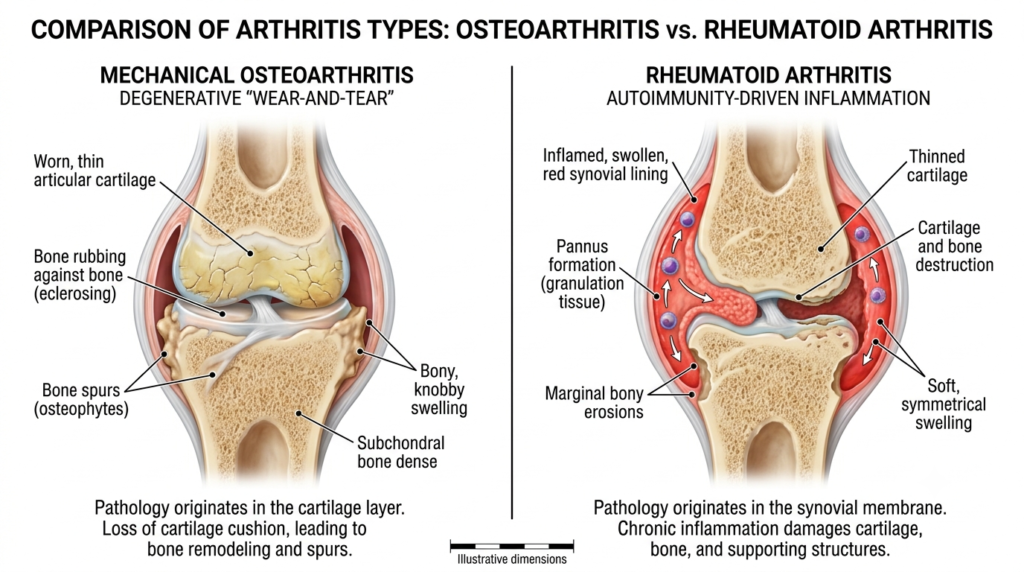
Osteoarthritis (The Mechanical Disease): Often referred to as “wear-and-tear” arthritis, OA is a degenerative joint disease. Healthy joints are capped with a smooth, protective cartilage that allows bones to glide over each other effortlessly. In OA, years of mechanical stress, previous injuries, or obesity cause this cartilage to gradually wear away. Eventually, the bones rub directly against each other, causing localized inflammation, bone spurs (osteophytes), and severe pain. It is primarily a localized, mechanical issue.
Rheumatoid Arthritis (The Autoimmune Disease): RA has nothing to do with mechanical wear. It is a systemic autoimmune disorder where the body’s immune system erroneously identifies the synovium (the delicate lining of the joint capsule) as a foreign pathogen. The immune system attacks this lining, causing massive inflammation, swelling, and a buildup of synovial fluid. Over time, this chronic inflammation destroys the cartilage and the bone itself, leading to severe joint deformity. Because it is systemic, RA can also attack the heart, lungs, and eyes.
Clinical Red Flags: Distinguishing the Symptoms
When evaluating rheumatoid arthritis vs osteoarthritis, clinicians look for specific patterns in how and when the pain presents.
1. The Onset and Age Factor
- Osteoarthritis: Typically develops slowly over many years. It is most common in patients over the age of 60, though it can occur earlier in athletes or individuals with prior joint trauma.
- Rheumatoid Arthritis: Can develop rapidly over a few weeks or months. It frequently strikes much earlier in life, typically presenting in patients between the ages of 30 and 50.
2. Pattern of Joint Involvement (Symmetry)
- Osteoarthritis: Usually asymmetric. A patient may have severe OA in their right knee from an old sports injury, while their left knee is perfectly healthy. It primarily affects weight-bearing joints (knees, hips, lower back) and the joints closest to the fingertips.
- Rheumatoid Arthritis: Characteristically symmetric. If the knuckles on the right hand are swollen and inflamed, the knuckles on the left hand will also be affected. It frequently targets the smaller joints first, such as the wrists, hands, and feet.
3. Morning Stiffness (The Telltale Sign)
- Osteoarthritis: Patients may wake up feeling stiff, but this “gelling” sensation usually resolves within 15 to 30 minutes of moving around and starting their day.
- Rheumatoid Arthritis: Morning stiffness is profound and debilitating, often lasting longer than an hour, and sometimes for the majority of the morning.
Clinical Comparison Table
| Clinical Feature | Rheumatoid Arthritis (RA) | Osteoarthritis (OA) |
|---|---|---|
| Root Cause | Autoimmune system malfunction. | Mechanical wear and tear of cartilage. |
| Symmetry | Symmetrical (both sides of the body). | Asymmetrical (often starts on one side). |
| Morning Stiffness | Lasts longer than 1 hour. | Resolves in less than 30 minutes. |
| Systemic Symptoms | Fatigue, low-grade fever, weight loss. | None. Symptoms are confined to the joints. |
| Primary Joints Affected | Wrists, knuckles, balls of the feet. | Knees, hips, spine, ends of fingers. |
The Diagnostic Workup
Because the treatment protocols are vastly different, securing an accurate diagnosis is critical. A rheumatologist will utilize a combination of imaging and serological (blood) tests:
- Blood Tests for Inflammation: Patients with RA will typically show highly elevated inflammatory markers, specifically the Erythrocyte Sedimentation Rate (ESR) and C-Reactive Protein (CRP). These are usually normal or only slightly elevated in OA.
- Specific Autoantibodies: A blood test checking for Rheumatoid Factor (RF) and Anti-CCP antibodies is crucial. If these are positive, it strongly indicates RA.
- Radiographic Imaging (X-Rays):
- In OA, X-rays will show joint space narrowing (as cartilage vanishes) and the formation of bone spurs.
- In RA, early X-rays may be normal, but ultrasound or MRI will show active synovial inflammation. Late-stage RA X-rays show bone erosions and joint subluxation.
Management and Treatment Strategies
Understanding the correct diagnosis of rheumatoid arthritis vs osteoarthritis is the most critical step before starting any treatment plan.
- Treating Osteoarthritis: The focus is on pain management and reducing mechanical stress. Weight loss is the most effective intervention. Physical therapy, NSAIDs (like Ibuprofen), and corticosteroid joint injections are common. In severe cases, surgical joint replacement (arthroplasty) is required.This localized mechanical wear is the primary difference when looking at rheumatoid arthritis vs osteoarthritis.
- Treating Rheumatoid Arthritis: The goal is to halt the immune system’s attack to prevent permanent joint damage. This requires Disease-Modifying Antirheumatic Drugs (DMARDs), such as Methotrexate, or advanced biologic therapies (injections or IV infusions) that specifically target immune system pathways. Early aggressive treatment is vital.
Medical Disclaimer
Disclaimer: The information provided on MedNode regarding rheumatoid arthritis vs osteoarthritis. The information provided on MedNode, including text, graphics, images, and other material contained on this website, is for educational and informational purposes only. It is not intended as a substitute for professional medical advice, diagnosis, or treatment. Always seek the direct advice of your physician or other qualified healthcare provider with any questions you may have regarding a medical condition.